How Low Pressure Casting Reduces Porosity in Aluminum Parts?
2026-06-22
Low pressure casting makes aluminum parts much less porous by controlling bottom-up filling that keeps air from getting trapped and causing turbulence. Using controlled pneumatic pressure between 0.02 and 0.1 MPa makes the liquid aluminum flow evenly into the mold hole. This stops the splashing and oxide formation that happen with gravity pouring. This laminar flow pattern, along with continuous feeding pressure during solidification, makes sure that any shrinkage holes are filled from the furnace reservoir below. This gives the parts better internal soundness, which is important for safety-critical uses in the aerospace, automotive, and industrial equipment sectors.
Understanding Porosity in Aluminum Castings
One of the biggest problems with quality in metal casting output is porosity. These very small holes or gaps appear when metal solidifies, and they can seriously weaken the mechanical stability of finished parts. When we look at casts that have failed, porosity is often the main reason why parts fail unexpectedly in tough situations.
Types of Porosity Affecting Aluminum Components
When hydrogen that is dissolved in liquid aluminum gets stuck while it cools, this is called gas porosity. Hydrogen is very attractive to aluminum, and it dissolves more easily at higher temperatures. This dissolved gas can't get out fast enough as the metal hardens, leaving round holes in the structure of the casting. Shrinkage porosity forms in a different way—it happens when the volume of a substance shrinks when it changes from a liquid to a solid. Without adding enough liquid metal to make up for this natural shrinkage, holes appear in larger areas or hot spots that aren't connected to anything else.
Impact on Component Performance
When there are internal gaps, stress concentration points form that make tiredness life much shorter. These flaws can cause catastrophic breakdowns in car suspension parts and motor housings when they are loaded and unloaded over and over again. Surface-connected porosity also lowers pressure-tightness, so parts can't be used in places that carry fluids, like valves or transmission housings. When purchasing teams look at what suppliers can do, they need to give more weight to casting methods that consistently deal with these basic mechanical issues. This will ensure the long-term dependability of the parts.
Root Causes Engineering Teams Must Address
When you fill a mold with turbulent air, it helps the oxide film form on the top of the melt. These oxide films fold into the casting, making flat flaws that can become crack start points. If you don't keep the temperature right, the material will solidify too quickly, blocking feeding paths and leaving shrinkage gaps. When engineering managers and quality leaders understand these mechanisms, they can choose the right casting methods that get rid of these defect sources instead of just reducing their impact.
How Low Pressure Casting Works to Reduce Porosity in Aluminum Parts
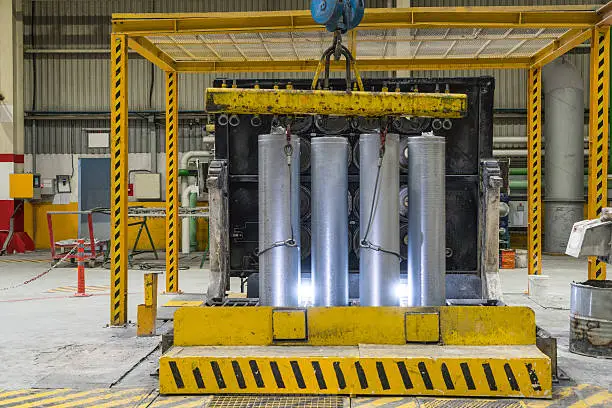
This counter-gravity process is unique because it can control how quickly it fills up. Through a refractory lift tube, a sealed holding furnace is linked directly to the mold body. The liquid metal is gently pressed on by compressed air, which forces the aluminum up through the tube and into the mold from below.
Controlled Pressure Profile Eliminates Turbulence
The low pressure casting process only works in a small pressure range, 20 to 100 kPa, which is carefully set by PID-controlled pressure curves. This slow rise in pressure creates laminar flow at the gate entry, which stops the splashing and turbulence that happen with gravity pours. The melt front moves easily upward, which keeps the surface from oxidizing and trapping air. This basic difference is important to mechanical engineers because it stops porosity formation at its source instead of trying to fix chaotic filling with extra steps.
Continuous Feeding During Solidification
Unlike other ways where risers freeze off too soon, the heated furnace below keeps the liquid metal supply steady during the solidification cycle. As the casting gets smaller, the pressure keeps forcing liquid aluminum from the storage into it, which makes up for the loss of volume. This constant feeding path keeps working until the casting is fully solidified. This gets rid of the small holes that form when sections with thick walls shrink. When the pressure is released, any liquid that is still in the riser tube runs back into the furnace. This helps to increase material yields to over 90%, which is a big jump from the normal 50 to 60% for gravity casting with traditional risering systems.
Thermal Management Enhances Microstructure
As a result of the process, the solidification moves inward from the mold walls, with the gate area hardening last while still being tied to the liquid reservoir. This difference in temperature makes sure that the right eating routes stay open while the food cools down. The microstructure that forms has fine, uniform grains and few holes. This means that the castings can go through the T6 heat treatment, which is very helpful for parts that need to be as strong and flexible as possible but can't be made with high-pressure die castings because of the trapped gas.
Key Benefits of Low Pressure Casting for Aluminum Porosity Control
Getting rid of porosity directly leads to measured performance gains that affect choices about buying and prices over the lifecycle. We've seen how these changes to the metal give real value across a number of evaluation factors that are important to sourcing leaders and tech teams.
Superior Mechanical Properties Enable Lightweighting
The microstructure is dense and free of holes, so it has tensile strengths that are 15 to 20 percent higher than similar gravity casts made of the same metal. After the T6 heat treatment, elongation values also get a lot better, often hitting 8–12% in A356 metal. This increased flexibility is very important for safety-important parts of car suspensions and aircraft structures that need to take impact energy without breaking easily. The better strength-to-weight ratio lets design engineers cut down on wall thickness and total component mass while keeping structure performance. This directly helps with efforts to make electric vehicles lighter and programs that try to save fuel.
Reduced Scrap Rates Lower Total Cost
When porosity is managed in a planned way, rejection rates for defects go down by a huge amount. Our output data shows that established methods have scrap rates below 2%, while gravity casting operations usually have rates between 5 and 8%. This stability in quality cuts down on rework costs, shortens wait times, and makes delivery more reliable. These are all things that have a direct effect on the total cost of ownership, which goes beyond the price of each part. More and more, procurement teams are realizing that choosing a provider based only on the price per piece they give often ignores the hidden costs that come with quality variations and supply chain disruptions.
Pressure-Tight Integrity Expands Application Range
By getting rid of linked porosity, castings can pass strict leak testing standards that are needed for hydraulic manifolds, transmission housings, and electric motor cases. When parts are checked using pneumatic pressure decline methods, they always have leak rates below 10⁺ mbar·L/s. This makes it easier to build things and cuts down on the need for expensive extra steps like secondary sealing or impregnation treatments that add doubt and process steps.
Comparing Low Pressure Casting with Other Casting Methods Regarding Porosity
By knowing the technical differences between casting methods, procurement workers and engineering teams can choose the best technology for each part's needs. There are pros and cons to each method when it comes to controlling porosity, production costs, and design options.
Low Pressure Casting versus High-Pressure Die Casting
Injection speeds of more than 40 m/s make high-pressure die casting possible, which results in a smooth surface and short cycle times. But this extreme turbulence always holds air and makes gas holes in the structure of the casting. Because burning happens when trapped gas grows at high temperatures, the parts that are made can't go through solution heat treatment. Different methods must be used for parts that need to be heated to achieve their maximum strength. Low pressure casting's counter-gravity filling works at metal speeds of less than 0.5 m/s, creating the stable mold filling needed for gas-free casts that can go through the full T6 heat treatment. Cycle times are longer—usually two to four minutes compared to thirty to ninety seconds for high-pressure die casting—but the integrity of the metal makes up for this in structural uses where mechanical traits must not be compromised.
Advantages Over Gravity and Sand Casting
In traditional gravity casting, hydraulic head pressure makes the metal drop into the mold hole in a rough way. Because of this turbulence, oxide films and air entrainment form, which means that bigger steps are needed to make up for less efficient feeds. It's possible to make complicated shapes with sand casting, but the microstructures are rougher and have more holes because the filling dynamics aren't controlled and the solidification rates are slower. The controlled pressure profile of low pressure casting combines the accuracy of permanent mold processes with better feeding efficiency, making it possible to get tighter tolerances (usually ISO 8062 CT6–CT7) and finer grain structures than either method can. Dimensional consistency is very helpful for parts that need to be machined with few tolerances and whose mechanical qualities need to be consistent across production lots.
Selection Criteria for Procurement Decisions
The method choice is based on the complexity of the parts, the volume of output, and the quality standards. This is good for things that are made in large quantities and don't need a lot of mechanical support. low pressure casting works well with complicated shapes that have inner cores because the mild pressure (about 1 bar) doesn't crush the resin-bonded sand cores. This lets the complex inner passages work to cool or reduce weight. Safety-important parts that need to be able to be tracked, X-rayed, and have approved mechanical features need the metallurgical integrity that can only be regularly achieved by controlled-pressure or vacuum-assisted methods.
Best Practices and Design Guidelines to Minimize Porosity in Low Pressure Aluminum Castings
To get the best results, you need to pay close attention to process factors, mold design, and quality checks all the way through production. Foundries with a lot of experience use strict controls on all of these interconnected factors to make sure they give regular, defect-free parts.
Process Parameter Optimization
Keeping the right pressure-rise rate is a key part of being successful in low pressure casting. During the filling phase, the pressure is usually raised slowly over 20 to 40 seconds so that the mold fills smoothly without any turbulence. Once the mold is full, the holding pressure goes up a little and stays the same while it solidifies, which can take anywhere from 60 to 120 seconds based on the thickness of the part. This makes sure that the feeding keeps going. Controlling the temperature of metal within ±5°C stops it from solidifying too quickly or absorbing too much hydrogen. For aluminum alloys, preheating the mold to 200–250°C helps keep the right temperature gradients. These factors need to be constantly checked by automated control systems that make changes in real time based on sensor data from the casting cycle.
Intelligent Mold and Gating Design
The filling design and feeding path are set by where the gates are placed. By putting gates at the deepest part, this area can harden last while still being linked to the pressurized tank. This eliminates shrinkage porosity in important areas. Mold drainage gets rid of air ahead of the moving metal front without letting metal leak out. Thermal modeling software predicts how things will solidify, which lets engineers find the best places for cooling channels and mold shapes before making the tools. Using chills in a smart way speeds up cooling in isolated hot spots, which helps solidify in a direction toward the gate. When making complicated castings with different wall thicknesses or detailed coring, these design factors become even more important.
Advanced Quality Verification Methods
According to ASTM E155 guidelines, radiographic analysis can find internal porosity without damaging the material. Important parts for cars and airplanes usually need Level 1 or 2 porosity grades, which set tight limits on the largest and most common holes that can exist. X-ray fluoroscopy lets you check things in real time while a process is being developed. For protected housings, pressure decay leak testing makes sure that parts don't let air in. Testing coupon bars cut straight from castings, not test pieces that were poured separately, shows that the mechanical qualities that were achieved in production are correct. Spectral analysis checks the chemistry of alloys, especially the amount of iron below 0.15% and the amount of strontium change that affects how flexible they are. These merged quality controls give people more faith in the dependability of the parts and help the process keep getting better by using data-driven analysis.
Partnering with ISO 9001-certified providers who show these systematic controls makes sure that you have access to engineering help during the design development, approval of prototypes, and ramp-up of production for larger orders. Foundries with a lot of experience give early feedback on Design for Manufacturability (DFM), which finds possible porosity risks and suggests design changes that make the part easier to cast while still meeting functional needs.
Conclusion
Controlling porosity is a key part of making sure that low pressure casting aluminum castings are of high quality and that parts work reliably in tough situations. Controlled counter-gravity filling and continuous pressure feeding are built into this process. They get rid of the turbulence and poor feeding that are problems with other methods. Better mechanical properties, lower scrap rates, and pressure-tight integrity that opens up design options are all measured benefits for engineering teams and buying pros. When you know the technical differences between casting methods, especially when it comes to mold filling dynamics, microstructure development, and heat treatability, you can make smart choices about where to get parts that meet performance needs and minimize lifecycle costs.
FAQ
What aluminum alloys work best with this counter-gravity process?
A356 and ADC12 alloys are used most often because they are easy to make and have good mechanical qualities after being heated. A356 is very flexible and can stretch 8–12% after being treated with T6, which makes it perfect for building parts. Controlled solidification can also be used for special alloys like A357 that are used in aircraft uses that need the highest strength-to-weight ratios. Which alloy to use relies on the application's specific needs for mechanical properties, resistance to corrosion, and heat conductivity.
How do typical lead times compare to other casting methods?
Usually, making a mold and developing a prototype takes four to six weeks. After that, checking the prototype and making sure it fits correctly takes two to three weeks more. Lead times for production are between 3 and 5 weeks, based on the size of the order and how complicated the work is. These schedules are longer than those for high-pressure die casting, but that's because of the extra steps needed to make sure the parts are defect-free. Suppliers with a lot of experience keep popular cutting materials in stock and make sure that schedules are optimized to keep project times as short as possible.
Can this process accommodate both prototype and production volumes?
The process works well for prototypes with 50 to 100 pieces up to production runs with more than 100,000 pieces per year. With proper care, permanent plastic tooling can last between 30,000 and 50,000 rounds, which makes it a good choice for medium-volume production. Using sand cores in modeling lets you use complex shapes without having to spend a lot of money on tools like you would for die casting. This lets you make changes to your design many times before committing to large-scale production.
Partner with Fudebao Technology for Porosity-Free Aluminum Castings
Zhejiang Fudebao Technology is a leading aluminum factory that makes accurate parts for use in cars, factories, and spacecraft. Our factory has special low pressure casting machines, high-speed CNC machining centers, and advanced inspection tools that work together to make the whole manufacturing process, from melting the metal to treating the surface. We always get measurements that are accurate to within 0.05 mm and porosity levels that meet ASTM E155 Level 1 standards. Our engineering team offers full DFM help and rapid prototyping to make sure ideas work before investing in production tools. Get in touch with our technical experts at hank.shen@fdbcasting.com to talk about your unique component needs and get accurate quotes for your project.
References
American Foundry Society, "Permanent Mold Casting Handbook: Low Pressure Technology and Applications," 2019.
Campbell, J., "Complete Casting Handbook: Metal Casting Processes, Metallurgy, Techniques and Design," Butterworth-Heinemann, 2015.
Kaufman, J.G. and Rooy, E.L., "Aluminum Alloy Castings: Properties, Processes, and Applications," ASM International, 2004.
ASTM International, "ASTM E155-15: Standard Reference Radiographs for Inspection of Aluminum and Magnesium Castings," 2015.
Bonollo, F., Urban, J., Bonatto, B., and Botter, M., "Gravity and Low Pressure Die Casting of Aluminium Alloys: A Technical and Economical Benchmark," La Metallurgia Italiana, 2005.
Outmezguine, A. and Tszeng, T.C., "Process Modeling and Optimization of Low Pressure Permanent Mold Casting," International Journal of Metalcasting, Volume 8, Issue 3, 2014.



_1756345939856.webp "Aluminum casting chassis")
_1756350046757.webp "Heat sink aluminum casting")
_1756346043433.webp "guardrail connecting block")