Strategic Comparison: Sand Casting vs. Die Casting for Large-Scale Aluminum Projects
2026-06-30
When engineering managers and sourcing directors have to make decisions about large-scale metal production, the choice between sand casting and die casting has a direct effect on the viability of the project, the reliability of the budget, and the performance of the parts. Sand casting uses replaceable molds made of bound sand mixes, which lets companies make aluminum parts ranging from small, lightweight brackets to huge, heavy structural housings that weigh several tons.
Die casting uses steel molds that can be used again and again and high-pressure injection methods to make sure that the accuracy is maintained for medium to large production runs. Procurement professionals can make decisions that balance short-term budget needs with long-term operational reliability in the energy, industrial machinery, and automotive sectors by understanding how these processes fit with requirements for dimensional accuracy, investments in tools, and production schedules.
Understanding Sand Casting and Die Casting Processes
Both techniques are useful for different things when making metal parts, and understanding how they work helps you know when to use each one for the best results. The following sections detail the operational mechanics of sand casting and die casting.
How Sand Casting Works in Aluminum Manufacturing
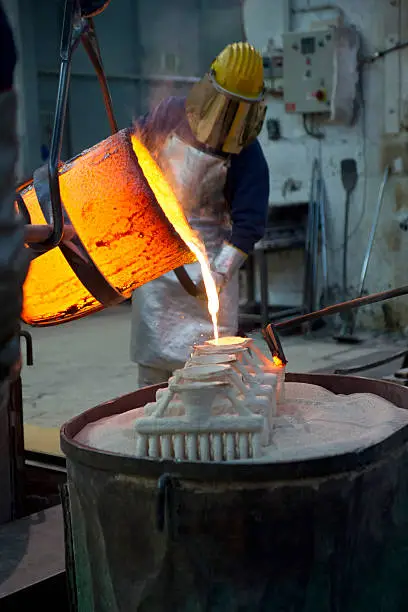
For sand casting, disposable molds are made from silica-based or synthetic sands that are mixed with clay (green sand) or chemical resins (no-bake systems). The shape of the part is set by making a pattern, and then sand is packed around the design to make the mold hole. At temperatures above 700°C, molten aluminum alloys are put into these molds, filling the complex spaces and hardening into the shape that is wanted. The sand mold falls apart as it cools, which is a trait called collapsibility. This stops hot tearing and works with metals that shrink a lot when they solidify.
Over 60% of all metal casts made in the world are done this way because it can be used with a wide range of materials and can be scaled up. Pattern lead times are usually between two and six weeks, which is much faster than making permanent tools. This makes sand casting a great choice for prototyping, medium-volume production, and big parts where die casting equipment limitations would be impossible to get around.
Die Casting Mechanics and Production Cycle
Die casting uses steel models that are precisely made and can withstand thousands of injection cycles. Under pressures ranging from 1,500 to 25,000 psi, molten aluminum is poured into the material, forcing it into thin-walled sections and fine features with few holes. The fast solidification and release cycle makes it possible to make more than a hundred parts per hour, which makes it perfect for making housings for cars, electrical casings, and parts for consumer electronics.
Tooling development requires a big investment up front and long lead times that can last for months, but once it's up and running, it offers great repeatability in dimensions. Due to machine mass and material flow requirements, the process naturally limits the size of the part. This makes it less useful for parts that weigh more than 50 kilograms or need very thick cross-sections.
Key Performance Dimensions: Comparing Sand Casting and Die Casting
When you compare these methods based on production number, cost structure, quality standards, and scaling, you can see which ones work best for your project.
Production Volume and Cost Efficiency
Sand casting is a cost-effective way to make anything from a single sample to several thousand units per year. Manufacturers can spread development costs over smaller batch sizes without losing money because they don't have to spend as much on original manufacturing. Pattern changes can be made quickly, which supports design iterations and requests for customization that are popular in uses in the energy sector and industrial machinery.
Die casting involves spreading out the cost of expensive tools over a large number of units. Depending on the complexity of the part, it usually stops being cost-effective above 5,000 units per year. Due to short cycle times and less work, the cost per unit goes down a lot as the production volume goes up. This is why die casting is the chosen method for car tier-1 suppliers that make tens of thousands of identical parts every month.
Dimensional Accuracy and Surface Quality Standards
The limits for dimensions in die casting are in line with ISO 8062 CT4–CT6 grades, and the surface finish usually reaches 1.6 to 3.2 Ra (microns) when the part is first made. This level of accuracy cuts down on the need for secondary machining on areas that aren't important, which lowers the cost and time of post-processing. Tolerances in sand casting are usually between CT10 and CT13, and surface finishes are between 6.3 and 12.5 Ra.
This means that CNC milling is needed for surfaces that need to fit together tightly and useful features that need to work properly. Purchasing managers need to include these tasks after casting in the overall budgets and schedules for manufacturing. Resin-bonded sand systems are better than green sand methods, even though they have less strict standard tolerances. They provide better dimensional stability for bigger casts that can't be made with die casting.
Scalability and Production Flexibility
Die casting machines can only handle parts that weigh up to a certain number of pounds, but sand casting machines can handle parts that weigh up to over 100 tons. This ability to grow is very important for companies that make heavy machinery and need gearbox housings, pump cases, and structure frames that are bigger than what can be made with die casting. Because the mold is disposable, complicated internal shapes can be made with sand cores, which means that cooling tunnels and empty sections can be made without the need for collapsible tooling mechanisms.
Die casting is great at making thin-walled structures with even thickness, which is important for making lightweight designs for cars where every gram saved helps meet fuel efficiency goals. Because the method can be used over and over, it supports statistical process control and Six Sigma quality efforts. It also lowers variation between production lots and makes PPAP documentation easier for OEM approval processes in the car industry.
Material Properties and Design Flexibility
The choices of aluminum alloys and how well they fit into different shapes are very different between these casting ways, which affects how well they work mechanically and how easily they can be made.
Alloy Compatibility and Mechanical Characteristics
Aluminum-silicon alloys (A356, A357) are often used in structural uses that need reasonable strength and good castability. They are cast in sand. Because sand molds solidify at a slower rate, the grain structures are bigger than in die casting, which changes the final tensile strength and elongation qualities. Some types of heat treatment, like T6 tempering, can improve the mechanical qualities of sand-cast parts, making them stronger than 280 MPa when they are pulled apart.
Die casting usually uses aluminum-silicon alloys that are designed to be fluid (A380, ADC12), which give the metal uniform mechanical qualities by solidifying quickly and having fine grain structures. These metals have tensile strengths of about 320 MPa when they are just made. They can't be heated much because trapped gases could cause blisters to form.
Design Adaptability and Geometric Capabilities
Sand casting lets the wall thickness range from 5 mm to several inches within a single part, so strengthening ribs and load-bearing sections can be added without worrying about the mold coming apart. This adaptability helps with prototyping when different versions of a design need to be tested with different wall thickness setups before the final specs are set. By using sand cores to make complex internal openings, makers can build cooling channels, fluid paths, and weight-reduction cavities directly into the casting, so they don't have to do any machining afterward.
Die casting has tougher design rules. Wall thickness must be fairly uniform, usually between 2 mm and 6 mm, to make sure the mold is fully filled and flaws are avoided. During the design process, draft angles, fillet radii, and undercut limits must be carefully handled to avoid problems with the tooling and ejection. Because of these limitations, design engineers and manufacturing teams need to work together more during the early stages of development.
Application Scenarios and Industry Use Cases
The right casting method must be chosen by knowing how each process meets the needs and goals of the specific industry.
Automotive and Transportation Applications
Because they are big, have complicated internal shapes, and are made in small to medium quantities, heavy-duty drivetrain parts like engine blocks and transmission housings often use sand casting. These parts need sand cores inside to make complex cooling paths and oil galleries that can withstand high temperatures and high combustion pressures over the course of a vehicle's life. Sand casting gives the walls the thickness and strength they need while also allowing for changes to the design during car development projects.
On the other hand, die casting is the most common way to make lightweight structural brackets, steering components, and electrical control unit housings, where large quantities support the cost of purchasing tools. Automotive OEMs make sure that these parts are all the same size so that they fit correctly on the assembly line and so that they don't have to do as many quality control samples. Die casting makes it easy to repeat processes like PPAP paperwork, which speeds up the qualification of suppliers and ongoing production approval.
Industrial Machinery and Energy Sector Requirements
Manufacturers of industrial equipment often use sand casting to make pump housings, compressor bodies, and valve systems because the parts need to be a certain size and the material needs to be strong. These parts work in harsh conditions with high pressures, toxic fluids, and wide temperature ranges. To do their jobs, they need strong wall sections and aluminum alloys that don't rust. Industrial equipment demand patterns, where production rates change based on market cycles and customer requirements, are aligned with the flexible batch production inherent to sand casting.
The ability of sand casting to incorporate heat dissipation features and mounting options without additional assembly processes is useful for energy sector applications such as motor housings for wind turbines and electrical cases for solar inverters. For smaller electrical parts that need precise size control for connector connections and heat management surfaces, die casting is a better option than sand casting, which would require too much machining to meet the standards.
Aerospace and Defense Component Manufacturing
For aerospace uses, lightweight, high-strength aluminum castings that meet strict approval standards and tracking processes are needed. When size and shape requirements are too high for die casting, sand casting is used to make solid bulkheads, landing gear parts, and engine mounts. To find flaws inside, these parts go through a lot of non-destructive testing, such as x-rays and ultrasound scans.
Material certificates show what alloys are used and what their mechanical properties are. Sand casting is often chosen for larger, complex-shaped primary structures and heavy-duty components, while die casting is used for secondary structures in aircraft and electronic housings, where tight tolerances make assembly changes harder and reducing weight has a direct effect on the payload capacity. Statistical process control and advanced inspection techniques are needed for both ways, and producers must keep thorough process documentation to meet the requirements of AS9100 quality management systems.
Strategic Decision-Making for B2B Procurement Managers
Informed casting method selection takes both technical and business needs into account, which helps projects run smoothly and builds good relationships with suppliers.
Evaluating Total Cost of Ownership
When procurement workers compare casting methods, they have to look at how long it takes to amortize tools, how much each unit costs to make, how much extra processing is needed, and how much quality assurance costs. Because sand casting requires less expensive tools, it lowers the financial risk of releasing new products and making guesses about how much demand there will be. This lets makers test the market for acceptance before committing to permanent tools.
Die casting has lower costs per unit when done in large quantities, but you need to be sure of your volume forecasts to cover the beginning costs. Total cost analysis should include machining limits. For die castings, less material needs to be removed, but for sand castings, milling techniques can be changed based on the as-cast dimensions. Cost structures are also affected by transportation procedures. Because sand casting can make parts close to their end weight, it wastes less material than die-cast blanks that need to be machined extensively.
Quality Assurance and Supplier Qualification
Strict checking procedures reduce casting flaws and make sure that parts work well. Optical Emission Spectrometry checks the chemical makeup of the aluminum alloy to make sure it meets the standards before it is poured, which stops problems that could happen if the wrong material is used. Tensile strength, yield strength, and elongation traits are checked mechanically using witness bars made alongside production parts. This makes sure that all production runs are the same. Ultrasonic study and other non-destructive testing methods find internal shrinking porosity, while magnetic particle inspection finds cracks on the surface.
Coordinate measuring machine scanning checks that the dimensions match up with CAD models and gives statistical data that helps with studies of process capability. When choosing a supplier, these quality control skills should be looked at along with their production ability, how quickly they can provide technical help, and their commitment to continuous growth. Long-term relationships with foundries that have a lot of experience help lower risk by setting up clear lines of communication and showing they can solve problems.
Conclusion
When it comes to big metal projects, deciding between sand casting and die casting means weighing production numbers, part shape, dimensional accuracy, and budget. Sand casting gives you the most options for medium-sized parts, parts with complex internal features, and large parts. You can also make prototypes and make changes more easily because you don't have to spend as much on tools. The accuracy of the dimensions and production effectiveness of die casting are better for high-volume uses.
The upfront costs of the tools are justified by the lower costs per unit and the lack of secondary processing. When choosing casting partners, procurement managers should look at the total cost of ownership, the supplier's technical know-how, and their ability to ensure quality. They should also make sure that the partner's skills match the needs of the project and the company's long-term business goals.
FAQ
Can Sand Casting Achieve the Same Detail Level as Die Casting?
Core systems in sand casting allow for complex shapes and internal features, but the limits for size and surface finish are still worse than in die casting. When compared to green sand methods, resin-bonded sand systems produce better surface quality, which means that less cutting is needed for semi-critical areas. Die casting naturally produces finer features and tighter standards, which makes it better for parts that don't need much post-processing.
What Are Typical Lead Times for Large Aluminum Casting Orders?
Making sand casting models takes two to six weeks, and then production can start soon after. Die casting tools need to be precisely machined and tested for several months, which delays original production but allows for faster output once they are up and running. When deciding when to start a product, project timelines should take these differences in tooling creation into account.
How Do Casting Methods Affect Aluminum Mechanical Properties?
The rate of solidification affects the structure of the grains and their mechanical properties. Because sand casting cools more slowly, the grains get bigger, so they need to be heated to make them stronger. Die casting quickly solidifies, making fine-grained structures with consistent mechanical properties in their as-cast state. However, heat treatment choices are restricted for some alloys because of worries about porosity.
Partner with Fudebao Technology for Your Aluminum Casting Needs
Zhejiang Fudebao Technology blends decades of foundry experience with cutting-edge production skills to offer sand casting and die casting services that are custom made for your project. Our integrated building has low-pressure casting machines, high-speed CNC machining centers, and full quality control labs. These allow us to make everything from molten aluminum to finished parts with tolerances of up to 0.05 mm. We provide PPAP paperwork, material certifications, and technical support throughout the lifecycles of products for car OEMs, industrial equipment manufacturers, and clients in the energy sector across North America. Get in touch with our engineering team at hank.shen@fdbcasting.com to talk about your aluminum casting needs and find out how working with a skilled sand casting provider can improve the reliability of your supply chain and the performance of your parts.
References
1. American Foundry Society (2021). "Sand Casting Process Fundamentals and Quality Control Standards for Aluminum Alloys," Technical Report Series, Volume 34.
2. Campbell, J. (2015). "Complete Casting Handbook: Metal Casting Processes, Metallurgy, Techniques and Design," Butterworth-Heinemann, Second Edition.
3. Davis, J.R. (1993). "Aluminum and Aluminum Alloys," ASM Specialty Handbook, ASM International, Materials Park, Ohio.
4. North American Die Casting Association (2019). "Product Specification Standards for Die Castings," NADCA Publication 403-2019.
5. Rooy, E.L. (1988). "Aluminum and Aluminum Alloys," Casting Volume of Metals Handbook, ASM International, Ninth Edition.
6. Society of Manufacturing Engineers (2018). "Metal Casting: Appropriate Applications for Sand Casting and Permanent Mold Processes," Manufacturing Engineering Fundamentals.



_1756352625880.webp "plug stainless")
_1756349794241.webp "round belt pulley")
_1756348780785.webp "porting turbo compressor housing")
_1756346310015.webp "Aluminum castings Crane bracket")