Sand Casting vs Die Casting: What Is the Difference?
2026-06-10
Sand casting vs die casting—what separates these two metal forming techniques? Sand casting uses expendable sand molds bonded with clay or resin to form metal parts, offering unmatched flexibility for complex geometries and diverse alloy choices. Die casting injects molten metal under high pressure into permanent steel molds, delivering precision and repeatability for mass production. The fundamental difference lies in mold material, production volume suitability, dimensional tolerances, and economic scalability. Understanding these distinctions helps procurement professionals align manufacturing methods with project specifications, budget constraints, and delivery timelines.
Understanding Sand Casting and Die Casting: Core Concepts
What Makes Sand Casting Distinctive?
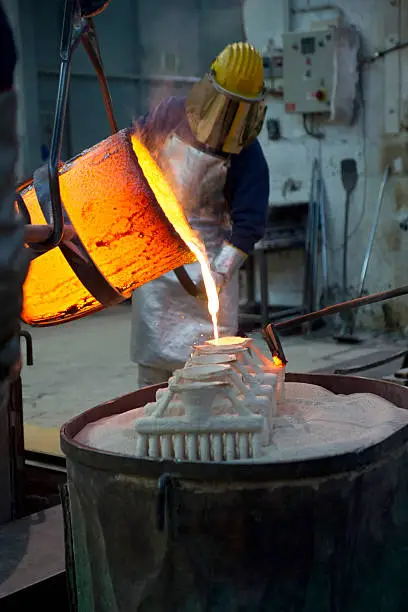
Sand casting, one of the oldest metal forming methods, accounts for 60% of worldwide metal castings. This procedure creates disposable molds using rigorously bound sand mixes, usually green sand (clay-bonded) or resin sand (chemically-bonded). To reveal the final component, the sand mold is shattered after molten metal solidifies in the cavity. Refractory sand can resist temperatures beyond 1600°C without melting, making it compatible with high-melting-point alloys including steel, iron, titanium, and aluminum.
How Die Casting Functions Differently?
Die casting uses reusable steel dies with accurate cooling passages and ejection mechanisms. Molten aluminum, zinc, or magnesium alloys are injected at 10–175 MPa. Rapid filling and controlled cooling allow for smooth surface finishes and dimensional uniformity. Die casting tooling lasts tens of thousands to hundreds of thousands of cycles, making it economically feasible only when production numbers justify the large upfront investment. Unlike sand casting, these molds are not discarded after each cycle.
Material Compatibility and Alloy Selection
Sand casting offers the most versatile alloy flexibility. We treat ferrous metals (gray iron, ductile iron, steel), aluminum alloys (A356, A380), copper alloys (bronze, brass), and even exotic materials like titanium and high-nickel superalloys. Applications needing corrosion resistance, thermal qualities, or magnetic properties require this adaptability. Die casting is primarily limited to low-melting-point non-ferrous alloys. Zinc die casting makes ornamental hardware and minor mechanical components, whereas aluminum die casting dominates automotive and consumer electronics.
Comparing Technical Aspects and Performance
Dimensional Accuracy and Surface Finish
Die casting has ISO 8062 CT4-CT6 dimensional tolerances and 1.6–3.2 Ra surface finishes. Low secondary machining costs reduce part production costs due to this precision. CT10-CT13 tolerances and 6.3–12.5 Ra surface polishes are typical of sand casting. Although less exact, sand casting can handle components from ounces to over 100 tons that die casting technology cannot accommodate.
We helped clients convert sand casting prototypes to die casting for scale production. Die casting's dimensional uniformity decreases assembly variance and boosts quality. For specialized industrial equipment components manufactured in batches of 50-500 pieces, sand casting's cheaper tooling costs and faster pattern adjustments improve project economics.
Mechanical Properties and Structural Integrity
Die-cast components have homogeneous mechanical characteristics due to quick solidification and regulated metallurgy. Fine-grained microstructures with strong tensile strength are produced, however ductility may be lower than heat-treated sand casting. T6 thermal treatment (solution treatment with artificial aging) improves ductility and impact resistance in sand casting aluminum alloys like A356. Safety-critical components that need shock absorption or fatigue resistance are best manufactured using sand casting.
Sand molds are collapsible while cooling, which minimizes hot ripping. This is a crucial advantage for metals with significant solidification shrinkage. Rigid die casting tooling can cause internal stresses in complicated geometries, necessitating careful gate and runner design to ensure structural integrity.
Production Volume and Lead Time Dynamics
Die casting cycles in 30 seconds to several minutes per part, making it ideal for high-volume manufacturing. Production scales quickly with low per-unit cost after tooling validation. Sand casting is suitable for low-to-medium volume runs (10-10,000 units per year) with cycle periods of hours to days depending on component size and cooling requirements.
Sand casting pattern making takes 20-30 days, compared to 8-16 weeks for die casting tool manufacturing. For prototypes, special projects, and design changes, this time advantage is crucial. We reduced time-to-market by 40% for clients utilizing sand casting for initial production runs while die casting tooling was built in parallel.
Cost Analysis and Economic Considerations
Tooling Investment and Break-Even Analysis
Sand casting requires little tooling investment—wood, resin, or metal patterns can be made depending on manufacturing quantity. Pattern expenses vary from low for basic geometries to substantial for sophisticated multi-piece designs. Precision-machined steel dies for die casting need a large upfront investment before manufacturing a single product.
The quantity of pieces, complexity, and machining needs determine the break-even point. When annual quantities surpass several thousand units and dimensional tolerances are important, we propose die casting. For manufacturing runs below this level, bespoke components, or design revisions, sand casting remains cheaper.
Unit Cost Structures and Scalability
Die casting has the lowest per-unit costs at large volumes because of fast cycle times, minimal labor, and few ancillary processes. With optimized metal flow, runner and gating systems maximize material use. Sand casting has greater labor costs for mold production and finishing, but material costs are competitive and sand is recyclable after reclamation.
Ongoing maintenance costs vary greatly. Die casting tooling needs frequent maintenance based on alloy temperature, production volume, and part complexity. Sand casting patterns last longer, but resin sand systems need mixing and reclamation equipment for environmental compliance and cost management.
Application Suitability and Decision Criteria
Where Sand Casting Excels in Industrial Applications
Sand casting is essential for complicated situations that require strong performance. Sand casting creates complicated engine blocks and cylinder heads for heavy-duty automobile powertrains. These components must survive severe temperature cycling and combustion pressures with complicated cooling pathways made of internal sand cores. The energy and oil/gas industries depend on corrosion-resistant superalloys like Duplex Steel to endure high-pressure deep-sea or caustic chemical conditions where failure is catastrophic.
Scalability makes sand casting ideal for heavy machines and construction. Sand casting excavator counterweights and gearbox housings guarantee earthmoving dependability with their bulk and vibration dampening. We made aluminum sand mold castings for explosion-proof lamp housings for petrochemical plants with thicker wall sections (>6mm) to fulfill Ex d flameproof ratings and pressure test criteria that die casting cannot cheaply accomplish.
Die Casting's Advantages in Precision Manufacturing
Die casting dominates automotive applications demanding exact dimensions and surface quality. This process ensures strict tolerances for millions of transmission housings, engine brackets, structural components, and electrical motor housings. PPAP documentation and long-term dimensional stability fulfill automotive quality standards for brand reputation and warranty compliance.
Consumer electronics use die-cast aluminum and zinc for temperature control and electromagnetic shielding. One procedure provides integrated heat sinks, intricate internal ribs, and mounting elements, lowering assembly costs and boosting product aesthetics. Die casting's flat surface reduces powder coating thickness, improving corrosion protection and tight-fitting assembly precision.
Environmental Compliance and Sustainability Considerations
Environmental standards apply to both processes, although they have different sustainability characteristics. You must discard or reuse leftover sand from sand casting, and certain binder systems release volatile chemical compounds during pouring. Modern resin sand casting systems with chemical reclamation are environmentally friendly, and green sand is practically indefinitely reusable with clay and moisture management.
Die casting's energy intensity is higher per unit time but lower per scaled unit. Remelting post-industrial scrap without degrading it makes aluminum die casting highly recyclable. Our closed-loop aluminum recycling systems decrease material costs and satisfy North American OEM sustainability goals.
Case Studies and Real-World Examples
Sand Casting Success: Monitor Enclosure for Marine Navigation
The maritime electronics company requested enclosures for bridge navigation screens exposed to sea spray, dampness, and direct sunlight. Although die casting was investigated, the modest manufacturing volume (800 units per year) and intricate interior cooling lines rendered sand casting economically preferable. We used aluminum sand mold casting using A356 alloy, chromate conversion coating, and powder coating for IP67 ratings.
Sand cores created internal geometries guiding airflow to prevent LCD crystal damage in high-temperature conditions in the enclosure, which functioned as a monolithic heat exchanger. Sand casting permitted pilot production design changes without expensive tooling adjustments, optimizing mounting features and cable entry points. The customer saved 30% over die casting while achieving performance and environmental durability requirements.
Die Casting Excellence: Automotive Structural Bracket Production
One automotive Tier 1 supplier needed lightweight structural brackets for electric car battery mounting systems. To guarantee optimum load distribution and crash performance, annual production predictions surpassed 250,000 units with ±0.15mm dimensional constraints. We used high-pressure die casting using A380 aluminum alloy to achieve 90-second extraction and trimming cycles.
Die casting integrated mounting bosses, cable routing clips, and alignment elements that would have needed extra processes with sand casting. CNC machining was confined to crucial mounting holes with ±0.05mm bolt torque tolerances. PPAP documentation confirmed dimensional consistency across production runs, and statistical process control showed Cpk values over 1.67 for all essential dimensions. The customer decreased assembly costs by 22% and met electric car range optimization weight reduction requirements.
Conclusion
Technical requirements, production numbers, and economic realities must be considered while choosing sand casting or die casting. Sand casting offers unrivaled flexibility for complicated geometries, massive components, various metals, and low-to-medium production quantities. At large volumes, die casting provides improved dimensional accuracy, surface polish, and per-unit costs. The best option relies on your application environment, quality criteria, and supply chain strategy. Both methods remain essential in contemporary production, tackling automotive, industrial, energy, and aerospace problems.
FAQ
Which casting method offers better precision for explosion-proof housings?
Sand casting can handle Ex d flameproof grade wall portions beyond 6mm and handles smaller volumes more cost-effectively due to cheaper tooling expenditures. We use resin sand for mold strength, computer modeling for gate and riser design to optimize feeding, and vacuum impregnation to seal micro-porosity for IP66/67 ratings. After shot blasting to remove sand, castings are coated with chromate conversion and epoxy-polyester powder for severe conditions, passing 1000-hour salt spray tests.
How do lead times compare between the two processes?
Sand casting tooling takes 20-30 days for pattern creation and sample approval, faster than die casting molds. Die casting tooling takes 8-16 weeks, depending on complexity. Die casting takes seconds to minutes per part, but sand casting takes hours to days. For low-volume applications, sand casting's tooling advantage speeds first-article delivery.
Can sand-cast components achieve the mechanical strength of die-cast parts?
Sand casting A356 alloy has better mechanical characteristics than die-cast alloys after T6 heat treatment (solution treatment + artificial aging), producing ductility that can withstand shock loads and thermal cycling. Material selection is application-dependent since die casting has constant tensile strength but lower elongation.
Partner with Fudebao Technology for Precision Casting Solutions
Navigating the complexities of sand casting and die casting requires a manufacturing partner with comprehensive capabilities and deep technical expertise. Zhejiang Fudebao Technology Co., Ltd. has specialized in aluminum alloy, copper alloy, and stainless steel casting and precision machining for over a decade, serving automotive, industrial equipment, machinery manufacturing, and energy sectors globally. Our facility integrates the complete production chain—from melting through casting, CNC machining, and surface treatment—delivering one-stop solutions from blank to finished product with tolerances reaching ±0.05mm. Whether you need cost-effective sand casting for prototype development or high-precision die casting for mass production, our engineering team collaborates with your specifications to optimize quality, delivery, and total cost of ownership. Contact our technical specialists at hank.shen@fdbcasting.com to discuss your project requirements and discover why leading OEMs trust us as their sand casting supplier for mission-critical components.
References
American Foundry Society. (2021). Casting Process Selection Guide for Engineers and Designers. Des Plaines, IL: American Foundry Society Publications.
Campbell, J. (2015). Complete Casting Handbook: Metal Casting Processes, Metallurgy, Techniques and Design (2nd ed.). Oxford: Butterworth-Heinemann.
Kalpakjian, S., & Schmid, S. R. (2014). Manufacturing Engineering and Technology (7th ed.). Upper Saddle River, NJ: Pearson Education.
North American Die Casting Association. (2020). NADCA Product Specification Standards for Die Castings (6th ed.). Wheeling, IL: NADCA.
Beeley, P. R., & Smart, R. F. (1995). Investment Casting and Sand Casting: Comparison of Process Capabilities. London: Institute of Materials.
ASM International. (2008). ASM Handbook Volume 15: Casting. Materials Park, OH: ASM International Handbook Committee.



YOU MAY LIKE
_1756352472762.webp "steel threaded plug")
_1756346421748.webp "Aluminum casting telescopic bracket Parts")
_1756346043433.webp "guardrail connecting block")